
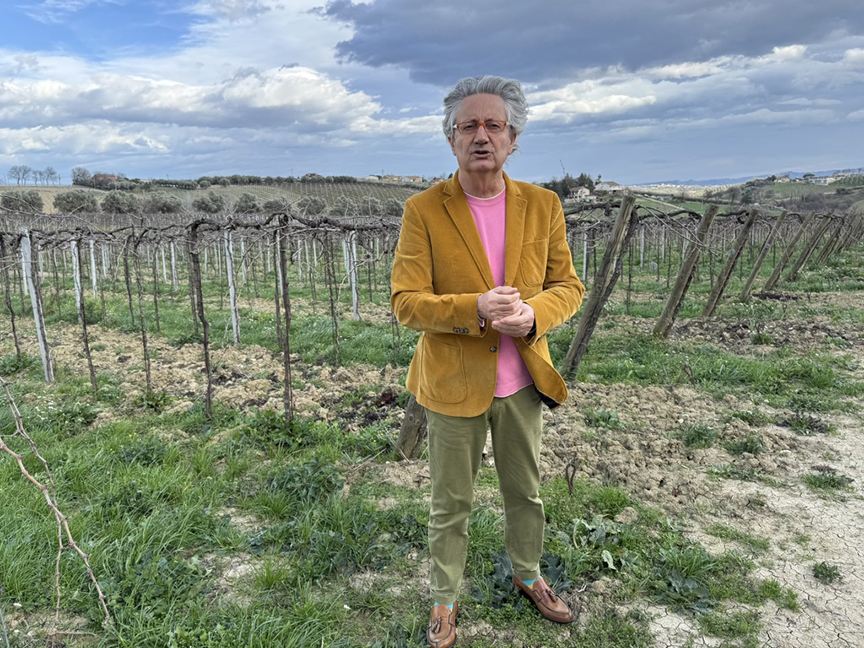
 Few in the U.S. know Abruzzo grower and winemaker Franco D’Eusanio (above) and his wines (Chiusa Grande). But in his native Abruzzo, his life and work are the stuff of legend.
He comes from a family of viticultural pioneers in Abruzzo. His father ran one of Italy’s most important wine grape nurseries and singlehanded helped the region to modernize its training methods.
Franco’s own work consulting with Abruzzo wineries has also reshaped grape growing practices in the region. But it is arguably his steadfast belief in organic viticulture and his vision for Abruzzo growers that will define his legacy as one of the region’s all-time greats.
I had tasted some of Franco’s wines over the summer during a dinner and tasting at the winery. But I had yet to spend time with him walking his vineyards and talking about viticulture.
He surprised me (and frankly blew my mind) when he started talking about unusual training methods he’s experimented in his quest to lower — yes, lower — acidity in the must. Tilling methods of his clay- and marl-rich soils is another key element, he explained, in his mission to create balance in his wines.
During my previous visit, I swooned over his stone-fermented Trebbiano “In petra” (vinified using a stone palmento, to borrow the Sicilian term). On this occasion, he poured me a macerated Trebbiano that I also loved and a grape I had never tasted: Maiolica, a rediscovered local variety, which delivered a light-colored but gently tannic and delicious red. It’s just another example of how he’s pushing the limits of Abruzzo viticulture.
After our tasting, I asked Franco what he studied at university. He started out with pure physics (!!!) but easily drifted toward agronomy and the family business.
I loved how an overarching vision forms his approach to growing and vinification. Producing wines with a perfect balance of acidity and phenolics is what guides him in every decision he makes.
I also loved his Abruzzo sheepdogs. Those are wounds from wolf bites on his head (below)! What a brave and loving dog. I didn’t think he was going to let me leave the property! He wanted to shepherd me!
The wines have some availability in the U.S. I highly recommend them.


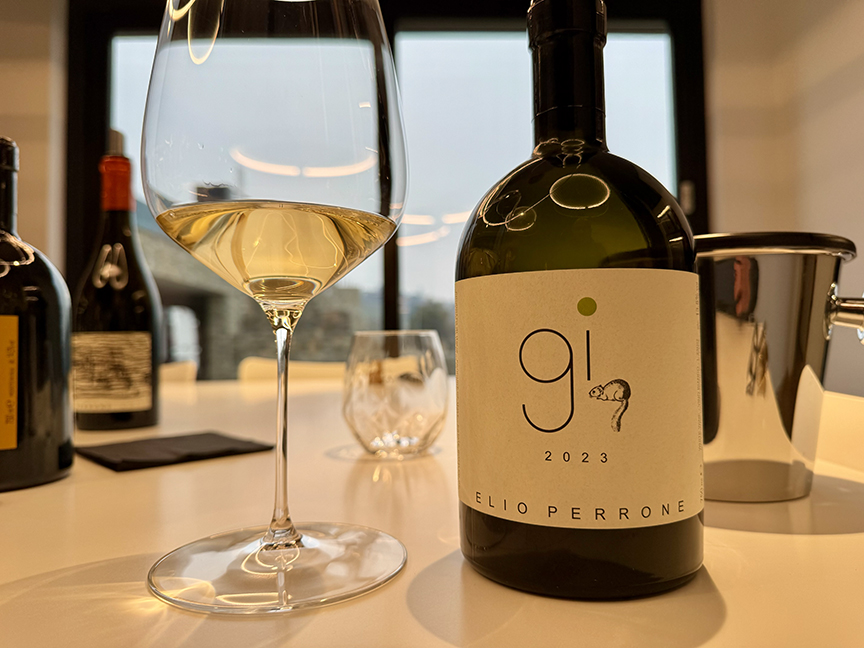
 Do Bianchi