
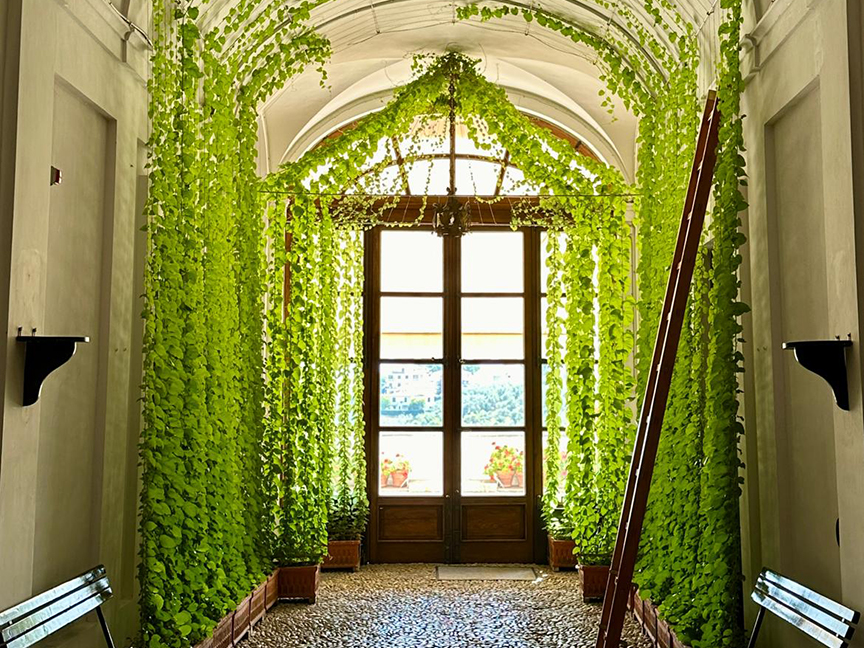
 Above: the Valentini family’s foyer is lined with living ivy.
The most remarkable thing happened during a visit with the Valentini family in Abruzzo in July.
After a long discussion of viticulture and climate change, Francesco Valentini — one of the most charismatic and eloquent winemakers I’ve ever met — asked us if we had any questions for him.
One of my colleagues said, “yes, I do. Thank you for this wonderful tasting and chat. Please tell us if there is something we can do for you.”
His eyes opened wide, as if he had been waiting for this moment the entire time.
“Yes, there is,” he said. “Please go out into the world and tell people about what I have just told you… If climate change continues, I will no longer be able to make wine the way I want to and I will stop producing wine.”
He pointed us to an article published in 2019 by the academic journal “Science of the Total Environment” entitled “Precipitation intensity under a warming climate is threatening some Italian premium wines.”
Authored by researchers at the Department of Psychological, Health and Territorial Sciences, University of Chieti-Pescara, and the Department of Meteorology and Atmospheric Science at Pennsylvania State University, the study uses data from Valentini dating back to 1820 when the winery began keeping records of harvest dates with each vintage. Valentini offered the scientists a unique trove of information that stretched back nearly 200 years.
“Although the impact of precipitation amount and drought on wine grape phenology have been investigated,” write the authors,
- knowledge of the role of precipitation characteristics is very limited. Here we show that the precipitation intensity, which is the precipitation amount divided by the number of the rainy days (NRD), has also caused early grape harvest dates for one grape varietal. Using the harvest dates (1820–2012) of a premium wine made by a winery that has kept the cultivation methods and practices unchanged since 1650, we found that for growing seasons since 1960, annual harvest dates have been getting early as temperature increases (−5.92 days °C−1) and more intense precipitation events occur (−1.51 days/(mm/NRD)). Our results are consistent with the hypothesis that the increasing tendency of precipitation intensity could exacerbate the effect of global warming on some premium wines that have been produced for >400 years.
Read the entire abstract here.
Our meeting was one of the most compelling winery visits I’ve ever made. From the conversation to the wines, from the urgency of Francesco’s words to the dreadful thought that wines like these — world treasures — may cease to exist because of the greed and myopia of industry and politicians.
My heartfelt thanks goes out to Francesco, Elèna, and Gabriele Valentini for opening their home to our group. Warm thanks also to James Tidwell, Alisha Blackwell-Calvert, Christy Frank, and Tiffany Bobbs for joining me for the occasion. Photo by James Tidwell.
 Do Bianchi