
 Nearly every time I open and pour a wine for a wine lover or wine trade member, I’m reminded of Roland Barthes’ seminal 1957 book Mythologies. In particular, the much-cited essay “Wine and Milk” wherein he explores wine’s status as a “totem drink” and he examines its “varied mythology, which is not embarrassed by contradiction.”
I’m also reminded of a favorite poetry collection from childhood, Where the Sidewalk Ends by Shel Silverstein.
The title poem, although it has no relation to wine, provides a powerful image — at least in my mind — for understanding where terroir ends.
As in the ne plus ultra that recurs in the epic poems of Homer, Virgil, and Dante, the place where the sidewalk ends or where the Strait of Gibraltar represents the demarcation between the knowable and unknowable world.
That same allegory can be applied to the notion of terroir. For many observers and participants in the wine trade, both professional and laical, there often seems to be a ne plus ultra beyond the canonical boundaries of terroir.
But where do terroirs end and begin and where do mythologies consume and re-elaborate those terroirs?
Oh that mystical French lemma terroir! I’ll define it here as the unique confluence of climate, soil, geography, topography, exposure, human tradition and condition that shape agricultural products through the observable legacy of their influence in aroma, flavor, and texture, or lack thereof.
But terroir is also our historical and spontaneous perceptions of that same terroir, whether informed or misguided. As St. Augustine might have said, terroir does not exist without previous and future experience. Nor can it exist without mythology.
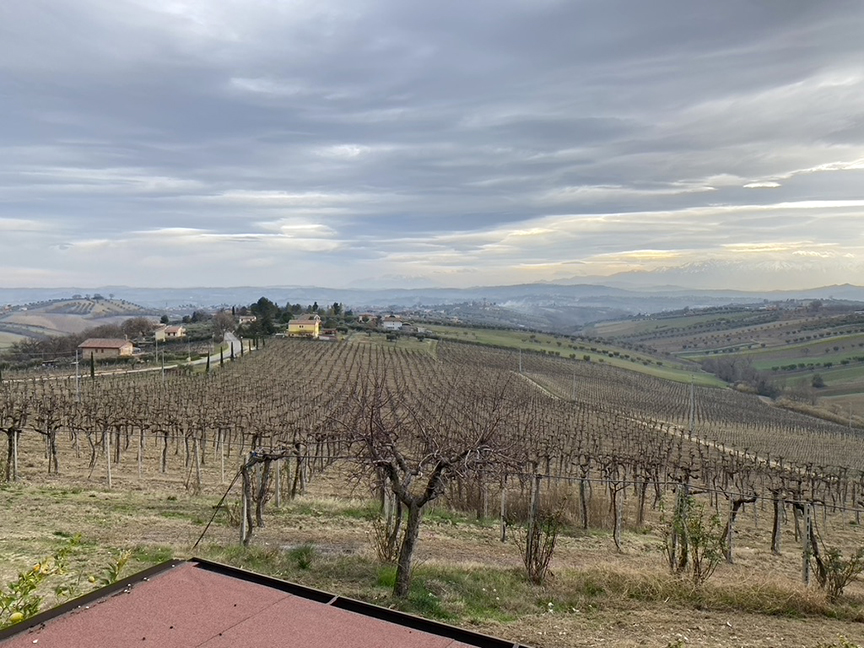
In February of this year, I stood at the edge of one of Abruzzo’s most famous farms in Controguerra. That’s a view of the Zanna vineyard at Illuminati. Note the tendone training and the (unseen) blue marl subsoils that in part define the terroir.
Few Americans make it to Illuminati. But throngs visit one of Illuminati’s contiguous neighbors. They won’t even notice any of the surrounding farms. Where do terroirs end? And where do mythologies begin?
 Do Bianchi