
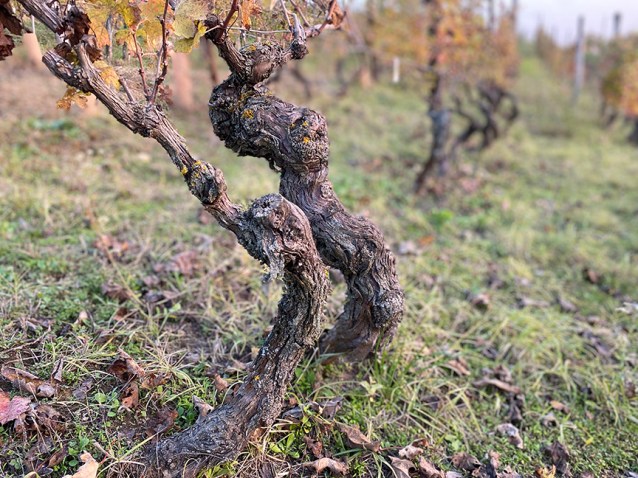
 Above: 90+-year-old Barbera vines in a vineyard owned by my client Amistà in the Nizza DOCG; photographed yesterday.
It’s a question and a topos that comes up often in winespeak: what are old vines and why are they important in winemaking?
While there doesn’t seem to be a broadly-embraced consensus on what constitutes “old vines,” most industry observers seem to agree that vines that are 50 years in age or older can definitely be referred to as “old vines.”
Nearly all winemakers and wine trade members concur that old vines make for higher quality wines. Old vines, the conventional wisdom goes, have less “vigor” than younger plants. As a result, they tend to focus their energy on a fewer number of clusters. Those bunches will have richer flavors and aromas, even though their yield — the volume of fruit they produce — will generally be smaller than for younger plants.
Many top producers reserve fruit from their oldest plants for their best wines.
Extremely old vines, like the ones in the image above, are also prized by winemakers because they can often be “ungrafted,” what Europeans sometimes call piè franco, meaning literally free standing.
Toward the end of the 19th century and in the early years of the 20th, many European vineyards were affected by phylloxera, a nearly microscopic insect that feeds on the roots and leaves of the plants. The only known cure for phylloxera is to graft the plants with rootstock from phylloxera-resistant plants. The know-how and phylloxera-resistant rootstock that was used to save the European wine industry came from the U.S.
In the case of the vines in the image, they were planted in the third decade of the last century and for reasons unknown were naturally resistant to phylloxera. They never needed to be grafted with American rootstock.
Ungrafted, piè franco vines are highly prized because they represent a continuity with the pre-phylloxera era.
In my experience, wines made from old vines like the Nizza produced by Amistà, can be highly more compelling than their younger-vine siblings.
Can you really taste the difference in wines that come from piè franco plants? I don’t believe that you can. But the romance of drinking a wine from a vine that was planted before my grandparents were born does have a certain appeal.
 Do Bianchi