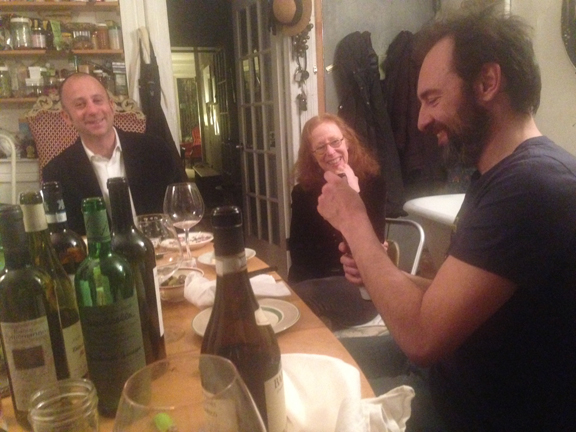
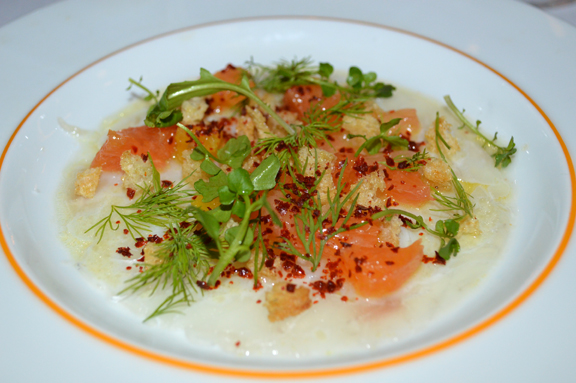
 Above: last night, Alice hosted Giovanni, his crew, and me in Soho for salad and cheese after we pigged out at Katz’s Delicatessen on the Lower East Side of Manhattan. It’s so important for me to eat leafy greens when I’m the road. Alice always hooks me up. Photo by Ben who was also in attendance.
Last night, as the Italians and I sat around Alice’s table, tasting wines and bantering about, I couldn’t help but think of how many English words Italians use in wine trade parlance. Even the word winemaker has found its way into the language of Dante: it’s used loosely and frequently in Italian to describe someone who may or may not have a degree or experience in formal enology yet who makes wine nonetheless. In Italian, an enologist can be a winemaker but a winemaker doesn’t necessarily have to be an enologist.
Giovanni (above) is a winemaker, for example, even though his winemaking partners Andrea and Nico are the formally trained enologists who arguably do more of the heavy lifting when it comes to the technical aspects of vinification. Giovanni carries his weight when it comes to pruning, racking, tasting, blending, etc. But no one would call him an enologo.
I was thinking about the use of English words in Italian after a new petition to encourage Italian leaders and marketers to eliminate Anglicisms from Italian was brought to my attention by my ex-college roommate — an American who has lived and worked in Italy for more than twenty-five years and who is perfectly bilingual.
It’s called Dillo in italiano (say it in Italian) and according to its online petition, it calls on “the Italian government, public administrators, members of the media, and businesses to speak a little bit more, please, in Italian.”
One of its pillars is based on an old Italian saying.
“In Italglish,” writes the author of the petition, “it’s easy to use terms clumsily, incorrectly, or inappropriately. Those who speak in the same manner that they eat speak better [Italian].”
The project has been spearheaded by Italian publicist/journalist Annamaria Testa and the topic began trending in English as well as Italian in late February after Italian humorist and essayist Beppe Severgnini published a New York Times op-ed entitled “Italy’s New Lingua Franca.”
“Beautiful though our language may be,” he wrote, “it is not the medium of choice for engineers when they’re building a beltway in Norway or designing a dam in Vietnam.”
The thorny question of Italian linguistic purism dates back to the Fascist era and beyond.
In 1977, in The Italian Language Today, the great Italian linguists Anna and Giulio Lepschy wrote the following account.
“During the Fascist period there were severe puristic relapses. As early as 1923, a tax as levied on foreign words used in shop signs, and at the beginning of the second world war, a law banned such words altogether; a poster appeared with ‘Italiani, bicottate le parole straniere’ ‘boycott foreign words’ (not untypically using the verb boicottare, which etymological dictionaries trace back to circa 1880, deriving it, through French, from the English ‘to boycott,’ from the name of Captain James Boycott, first victim of this treatment in Ireland). A Fascist law which prohibited the giving of foreign Christian names [i.e., first names] to Italian children was abolished as late as 1966.”
Listening to Nico, Andrea, and Giovanni speak (as I translated for Alice and Ben), I wondered how stilted our conversation would be if they eliminated all English words from their banter.
Thankfully, the three of them are progressivists and they embrace foreignisms with gusto (hey, was that just an Italian word I used?).
I am an unabashed lover of Italian and find great joy in my knowledge of Italian language and literature. But I also believe that — historically — one of the Italian language’s greatest strengths has been its ability to absorb words from other languages.
Winemaker is such a powerful word in Italian in part because it is borrowed. It represents a new generation of people who make wine in Italy as they break away from past paradigms and forge new ground. It doesn’t threaten Italian. It enriches it with its foreignness.
But, hey, what do I know? Io sono solo un semplice blogger. I’m just a humble blogger.
Speaking of Italians who say it better, check out this post today for the Franciacorta, the Real Story blog. It features Chef Vittorio Fusari and his wonderful and wonderfully concise description of Franciacorta.

 Man, it’s been a crazy week here in New York. The weather tried to keep me from getting here but I made it just the same through sheer determination. And all week, I’ve been slugging through the snow and the slush trying to keep up with my appointments and meetings.
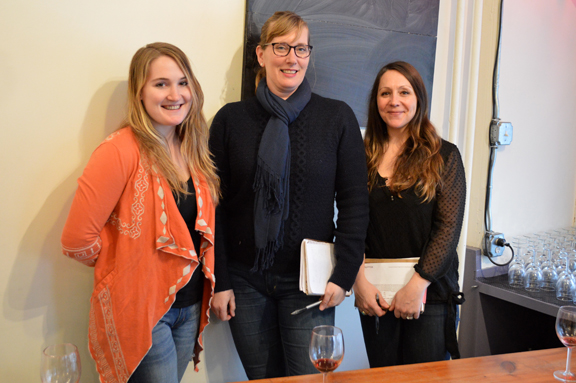
  In the meantime, I wanted to give a shout out to fellow Texan and Austinite Paula Rester (above) who moved to the city last year to take a job at Maialino as one of the restaurant’s sommeliers.
 Do Bianchi